


Orion Project
Spectrographic Comparison
Traditional Brass vs. EggWin Resin Mouthpiece
(2025 Trials)
The analysis uses two types of test samples.
-
Waveform/Spectrograms for Long Tones:
-
Top row (traditional brass): Shows more variation in amplitude and harmonic content across sustained notes. Waveforms are irregular with fluctuating intensity, and green bars highlight varying presence/strength of harmonics.
-
Bottom row (EggWin Reztone): Displays smoother, more consistent waveforms with flatter envelopes and more uniform green bars, indicating steadier harmonic excitation.
-
-
Full Spectrograms for a Lyrical Etude:
-
Top (brass) More varied harmonic content shown by colorful lines (red, orange, yellow) above the yellow fundamental pitch line. Harmonics appear stronger and more prominent in certain registers but less even overall.
-
Bottom (Reztone): Cleaner and more even distribution of harmonics across the frequency spectrum and range, with consistent colored lines above the fundamental, suggesting balanced overtone production throughout the passage.
-


Key Findings from the Visual Data
-
Overall sound quality — Shows little significant difference in harmonic structure; both mouthpieces produce a full spectrum of overtones typical for brass instruments.
-
Resin advantage — The resin mouthpiece appears slightly more even and stable throughout the instrument's range:
-
Smoother long-tone sustain with less decay variation.
-
More consistent harmonic excitation in dynamic lyrical playing, potentially leading to better intonation stability and uniformity across registers.
-
These trials suggest that modern 3D-printed resin mouthpieces (like Reztone) can closely rival traditional brass in tonal quality while offering advantages in consistency, making them a viable alternative for players seeking even response across the range.
Participants
-
Orion Munoz - Trumpet
-
Tristan Eggener - Low Brass
-
Dave Peterson - Trombone
-
Owen Miller - Woodwinds
Equipment
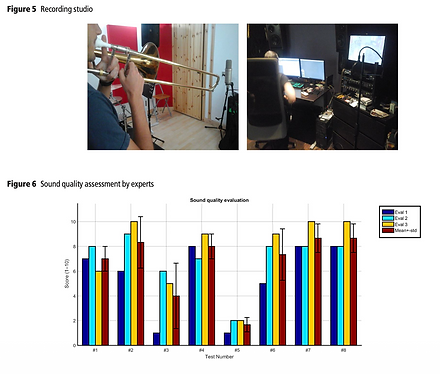
AKG C414 XLII
Ableton Live
Sonic Visualizer




In the world of brass instruments, tradition reigns supreme. For centuries, brass—specifically alloys of copper and zinc—has been the material of choice for crafting trumpets, trombones, euphoniums, and more. It's praised for its durability, malleability, and resonant qualities, forming the backbone of orchestral and ensemble music from biblical horns to Romantic-era compositions. Yet, as a musician and researcher, my personal journey has led me to question this unchallenged dominance. Why brass? Is it truly the optimal material, or merely a historical artifact of availability and inertia? Drawing from recent harmonic resonance trials conducted in 2025 by EggWin, which compared traditional brass mouthpieces to 3D-printed resin alternatives, and my own reflections on the matter, this essay challenges the "brass myth." The data suggests that modern materials like resin can rival or even surpass brass in consistency without sacrificing sound quality, prompting a broader reevaluation of our reliance on tradition. Ultimately, I argue that the brass community must embrace rigorous, scientific testing to uncover the true potential of alternative materials.
My affinity for resin mouthpieces stems from practical experience rather than mere novelty. Unlike traditional brass, which can irritate or fatigue the face during extended playing sessions, resin offers a gentler interface. Its lightweight nature and customizable design allow for tweaks tailored to specific performances—whether a symphony hall gig or an outdoor ensemble. Moreover, the durability of resin provides peace of mind; a accidental drop results in no dents or expensive repairs, unlike the fragility of metal counterparts.
These benefits, however, force a confrontation with deeper philosophical questions. Are we diluting the noble art of brass playing by adopting cheaper, synthetic materials? Does this shift signal a departure from the legacies passed down by generations of musicians, potentially ushering in a "dystopian" era of hybrid "frankenstruments"? Such concerns are not unfounded, as they touch on the cultural and historical value embedded in traditional craftsmanship. Yet, personal comfort and adaptability should not be dismissed as superficial; they enhance performance and accessibility, democratizing the instrument for a wider range of players.
To ground these reflections in evidence, consider the 2025 EggWin trials, which utilized spectrographic analysis to compare harmonic resonance between traditional brass mouthpieces and 3D-printed resin ones. The study focused on two scenarios: sustained long tones and a lyrical etude, measuring overtones via waveforms and full spectrograms.
In the long tones section, the traditional brass mouthpiece displayed irregular waveforms with fluctuating amplitude and varying harmonic presence (indicated by green bars), suggesting inconsistencies in sustain and intensity. In contrast, the resin mouthpiece produced smoother, more uniform waveforms and steadier harmonic bars, indicating greater stability across sustained notes.
For the lyrical etude, the brass mouthpiece showed a richer but uneven distribution of harmonics (colored lines above the yellow fundamental pitch), with stronger overtones in certain registers but overall variability. The resin version, however, exhibited a cleaner, more balanced harmonic spectrum, maintaining consistency throughout the passage's dynamic range.
Overall, the trials revealed little difference in fundamental sound quality—both mouthpieces generated a full overtone spectrum typical of brass instruments. However, the resin mouthpiece demonstrated a slight edge in evenness and stability, potentially improving intonation and response across registers. These findings challenge the notion that metal is inherently superior for resonance, as the "sacred geometry" of harmonic production appears independent of the material's oscillatory properties. If listeners in blind tests struggle to distinguish between the two, as anecdotal evidence suggests, why cling to brass out of habit?
This data opens a Pandora's box: if resin performs comparably in mouthpieces, what about entire instruments? Historical records indicate brass was selected for its abundance, cost-effectiveness, and ease of repair in pre-industrial eras. Alternatives like bronze, pure copper, or cupronickel might have sufficed, but brass prevailed through path dependence—a feedback loop where instrument shapes optimized over centuries for brass now disadvantage other materials in identical forms.
Yet, shockingly, comprehensive research on alternative metals remains scarce. Searches for studies using laser vibrometry or acoustic modeling yield few results, often locked behind academic paywalls. Wealthy patrons commission custom pieces from innovators like Harrelson, incorporating silver or titanium elements, but systematic trials on full instruments in gold, tungsten, or platinum are absent. Why aren't titanium euphoniums or solid silver trumpets commonplace? Claims of brass's "fullness and power" feel like unattributed opinions rather than objective science, echoing biases in fine arts where perception confirms preconceptions.
Bias further complicates matters. Inform a listener of a "titanium" trumpet, and they may perceive enhanced brightness due to the label's premium connotation. True inquiry demands blind testing to isolate material effects from psychological ones. Moreover, most brass instruments are lacquered, coating the metal in enamel that doesn't impair vibration—raising the question: why not use cheaper substrates beneath? The field's inertia, met with resistance or anger when challenged, reflects not innovation but complacency.
Comparisons to other instrument families highlight this gap. Woodwinds vary by species (e.g., grenadilla vs. rosewood), yielding distinct resonances, while strings benefit from tonal diversity in woods like spruce or maple. Brass lacks this exploration, despite potential for "better" materials in projection, tuning, or versatility.
The brass myth—that this alloy is the pinnacle of instrumental design—crumbles under scrutiny. My journey, fueled by personal preference for resin and supported by the 2025 trials' evidence of comparable (if not superior) evenness, reveals a field ripe for disruption. We've played metal horns for millennia without rigorously testing alternatives, blinded by tradition and cost.
It's time to act. I call upon musicians, researchers, and institutions to fund and conduct comprehensive studies: blind acoustic trials, vibrometric analyses, and full-instrument prototypes in diverse materials. Collaborate across disciplines—acoustics, materials science, and musicology—to challenge assumptions and innovate. Let's commission titanium trombones, gold trumpets, and optimized resin designs, evaluating them in live halls and dead rooms alike. Only through data-driven inquiry can we honor our ancestors' legacy while forging a future where the best material wins, not the most familiar.
As practitioners, we owe it to our art to question, test, and evolve. Join me in this pursuit—run your own trials, share findings, and let's shatter the myth together. The resonance of tomorrow awaits.